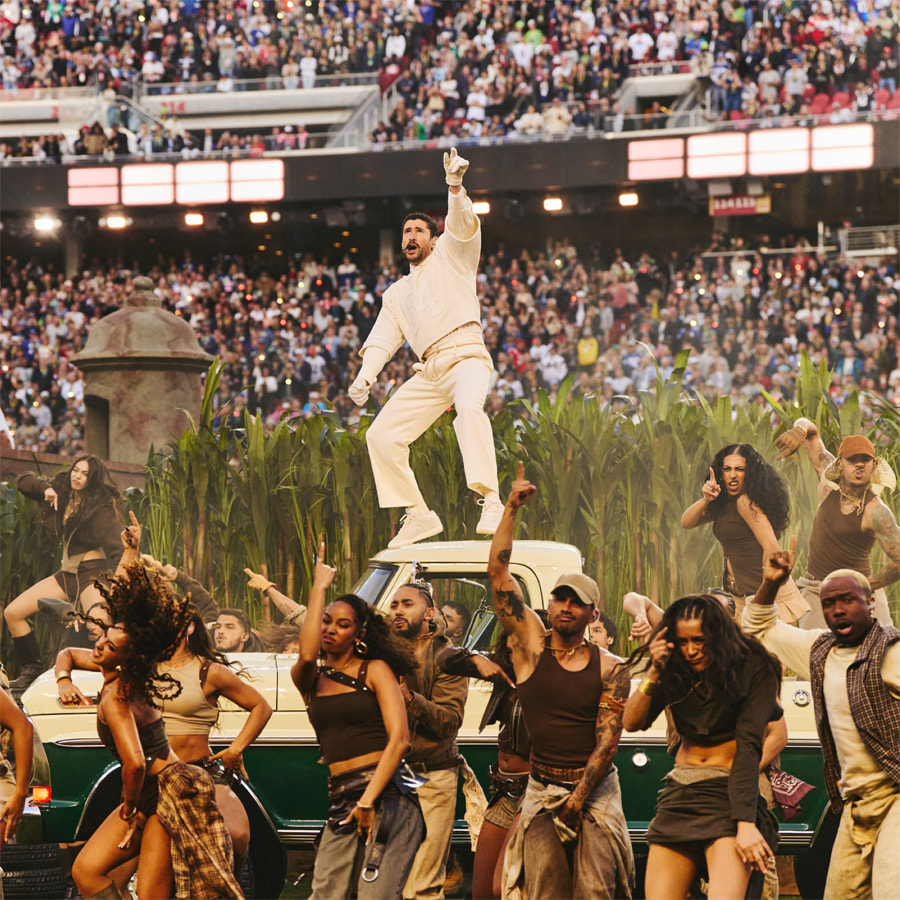
The Super Bowl halftime show has always been a strange cultural space. It’s not quite a concert, not quite a spectacle, and somehow expected to please everyone. That’s a nearly impossible task, and yet, every year, artists step onto the biggest stage in American pop culture and try anyway.
At Super Bowl LX on February 8, 2026, Bad Bunny didn’t try to please everyone. Instead, he made a statement.
A Performance Rooted in Identity
As the first Latino solo artist to headline the Super Bowl halftime show, Bad Bunny’s performance immediately carried cultural weight. From the opening moments, it was clear this wouldn’t be a watered-down set designed to fade politely into the background. The show leaned heavily into Spanish-language music, reggaeton rhythms, and visuals inspired by Puerto Rican neighborhoods and daily life.
Rather than chasing mass appeal through genre-hopping or nostalgia bait, Bad Bunny centered the performance around who he is and where he comes from. The result felt intentional, confident, and unapologetic.

Spectacle Without Losing Soul
Visually, the production was vibrant and cinematic. The stage design evolved throughout the set, blending choreography, lighting, and theatrical moments that kept the energy high without overwhelming the music. Surprise appearances, including Lady Gaga and Ricky Martin, added star power, but never pulled focus away from the central narrative of the performance.
Musically, the setlist stayed true to Bad Bunny’s catalog, emphasizing rhythm, movement, and crowd energy. It wasn’t a greatest-hits mashup meant to check boxes; it felt curated, purposeful, and alive.
More Than Entertainment
What truly set this halftime show apart was its message. Closing with the phrase “Together We Are America,” Bad Bunny framed the performance as more than a concert; it was a reflection of the evolving cultural landscape of the country itself.
For many viewers, this resonated deeply. Streaming numbers surged globally after the show, and social media buzzed with praise from fans who felt seen and represented on a stage that has historically favored a narrower definition of “mainstream.”

A Polarizing Moment By Design
Not everyone embraced the performance. Criticism surfaced quickly, much of it centered on the use of Spanish and the show’s cultural specificity. Some commentators argued it didn’t align with their expectations of what a Super Bowl halftime show “should” be.
But perhaps that reaction proves the point.
The halftime show has never been culturally neutral; it has always reflected who is allowed to take up space, whose stories are centered, and whose art is considered universal. Bad Bunny’s performance challenged those assumptions head-on.
Final Thoughts
Bad Bunny’s Super Bowl LX halftime show won’t be remembered as safe or forgettable, and that’s its greatest strength. It was bold, expressive, and deeply rooted in identity. Whether you loved it or questioned it, the performance sparked conversation, reflection, and debate, something the best art has always done.
In a moment designed for mass consumption, Bad Bunny chose authenticity. And on the biggest stage in American entertainment, that choice mattered.
Leave a Reply